The World Uncertainty Index Just Doubled the COVID Peak. Here’s What That Means for Crypto.
Global uncertainty hit 106,000 in Q3 2025 — a level that dwarfs every crisis since they started measuring. Markets are pretending…
Global uncertainty hit 106,000 in Q3 2025 — a level that dwarfs every crisis since they started measuring. Markets are pretending everything’s fine. The data says otherwise.
There’s a number that should terrify you. It’s not Bitcoin’s price. It’s not inflation. It’s not the VIX.
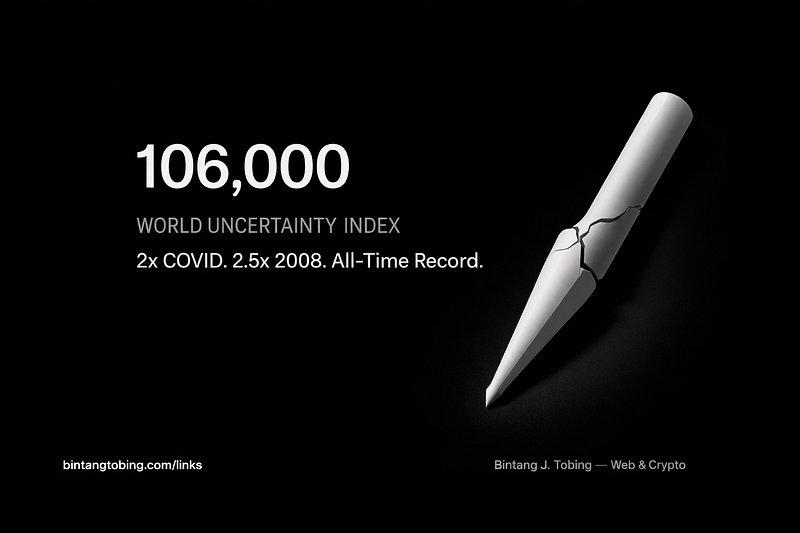
It’s 106,862.
That’s the World Uncertainty Index reading from Q3 2025 — the highest level ever recorded since the index was created in 1996. To put that in perspective: the COVID-19 pandemic peaked at roughly 50,000. The 2008 global financial crisis hit around 40,000. The current reading is more than twice the worst pandemic reading and nearly three times the Great Recession reading.
The WUI eased slightly to 94,947 in Q4 2025 — still almost double COVID’s peak. And here’s where it gets interesting for crypto: the traditional financial stress indicators are barely flinching.
The VIX sits around 32 — elevated, but nothing compared to the 80+ readings we saw during actual crises. The MOVE index (bond volatility) is subdued. The Fed’s Financial Stress Index shows no systemic strain. Markets are pricing in business as usual, while the actual data says we’re living through the most uncertain period in modern economic history.
That divergence is the story. And it’s the story that explains everything happening in crypto right now.
What the World Uncertainty Index Actually Measures
Before we get into implications, let’s get precise about what we’re looking at.
The WUI was developed by Hites Ahir (IMF), Nicholas Bloom (Stanford), and Davide Furceri (IMF). It’s constructed by counting how often the word “uncertain” and its variants appear in the Economist Intelligence Unit’s quarterly country reports for 143 countries, with weights based on GDP.
This isn’t social media sentiment. This isn’t a volatility gauge. These are professional analysts at the EIU — people paid to be measured and precise — writing about economic and political conditions in their assigned countries. When the word “uncertainty” appears at a record frequency across 143 countries simultaneously, it indicates something structural is happening.
The current reading translates to roughly 10–11 mentions of “uncertain” or “uncertainty” in a typical 10,000-word quarterly report per country. The historical average is around 3–4. The entire world’s economic analysis community is screaming “uncertainty” at a rate nobody has seen before.
Why 2025 Broke the Index
The drivers are clear, and they’re compounding.
U.S. trade policy underwent its most aggressive shift since the Smoot-Hawley era. The tariff escalations that began in early 2025 paused, then escalated again, creating a regime of permanent unpredictability in global supply chains. Companies can’t plan 12 months out when trade policy changes every 12 weeks.
AI disruption hit corporate planning cycles hard. The IMF’s April 2025 World Economic Outlook specifically called out AI uncertainty as a macroeconomic factor—the first time artificial intelligence appeared as a standalone risk variable in its models. When your cost structure might be obsolete in 18 months, every investment decision carries existential uncertainty.
Geopolitical fragmentation accelerated. U.S.-China tensions, Middle East instability, European political shifts, and the weaponization of economic policy created a multi-front uncertainty shock that no single crisis can explain.
Budget and fiscal uncertainty in the U.S.—with debt ceiling debates, government spending disputes, and policy reversals—added domestic instability to the global picture.
The result: the World Economic Forum’s May 2025 Chief Economists’ Outlook found that 82% of surveyed chief economists rated the current level of uncertainty as “very high.” Their September 2025 follow-up declared the global economy had entered a “new era of heightened uncertainty.”
The Divergence That Matters for Crypto
Here’s the critical disconnect: record text-based uncertainty, but subdued financial stress.
The IMF’s own November 2025 analysis noted this paradox: high uncertainty coexisting with positive economic sentiment. Their World Sentiment Index, which tracks the same EIU reports on economic outlook language, remains above the historical average despite the spike in uncertainty.
Translation: the world’s analysts are writing about record uncertainty while simultaneously maintaining relatively positive economic forecasts.
For crypto, this divergence creates two competing scenarios, and understanding which one plays out is the difference between generational returns and catastrophic losses.
Scenario 1: Uncertainty stays in the reports. If the record WUI readings remain confined to analyst language and do not translate into actual financial stress—no credit events, no liquidity crises, no systemic failures—then Bitcoin continues to trade as a high-beta risk asset, sensitive to rates and dollar strength but not facing existential macro pressure. In this scenario, the infrastructure buildout underway (Fidelity’s FIDD stablecoin, Tether’s MiningOS, European bank crypto adoption under MiCA) becomes the foundation for the next growth cycle.
Scenario 2: Uncertainty becomes stress. If the WUI readings are a leading indicator — and historically, the IMF’s own research shows uncertainty takes 6–18 months to impact growth through reduced investment, hiring, and consumer spending — then we’re in the early innings of a macro slowdown that will pressure all risk assets further. Bitcoin, with its 0.7+ correlation to Nasdaq since ETF adoption, would face sustained headwinds.
The honest answer: nobody knows which scenario plays out. But here’s what we do know — the stablecoin market at $315 billion is essentially flat over the past 30 days (down only 0.25%). That “dry powder” represents on-chain purchasing power that hasn’t evaporated despite Bitcoin’s 50% crash. It’s waiting for deployment.
What the Data Actually Tells Crypto Traders
Academic research on uncertainty and crypto is surprisingly clear. Studies using GARCH models and quantile regression consistently find that cryptocurrencies exhibit weaker hedging characteristics during periods of uncertainty than traditional safe havens such as gold.
Gold proved this in real-time: while Bitcoin dropped 26% YTD in 2026, gold surged 11% to $5,595/oz. The “digital gold” thesis failed its biggest test.
But there’s nuance. The research also shows that geopolitical acts — actual events, not just uncertainty language — tend to have a positive impact on Bitcoin returns. The distinction matters: pure uncertainty hurts crypto, but resolving uncertainty (in any direction) often creates catalysts.
This is why regulatory clarity matters so much right now. The GENIUS Act (July 2025) removed stablecoin ambiguity. The CLARITY Act is advancing through the Senate. Every piece of legislation that converts uncertainty into defined rules is a potential catalyst — not because the rules are always favorable, but because defined rules reduce the WUI’s impact on crypto.
The Infrastructure Signal
The WUI data reinforces the thesis from this week’s crypto recap: what’s being built amid this uncertainty matters more than the price.
Fidelity — managing $5.9 trillion — launched the Fidelity Digital Dollar (FIDD) on Ethereum. Tether released USAT and MiningOS. European banks ING and BBVA began offering crypto ETNs to millions of retail clients under MiCA. MetaMask integrated tokenized stocks. The stablecoin market now exceeds $315 billion.
This is institutional infrastructure being deployed during record global uncertainty. Historically, 2018–2019 winter produced DeFi, 2022–2023 winter produced ETF infrastructure — what’s built during the chaos becomes the foundation of the next cycle.
CryptoQuant data from February 6 showed a record 66,940 BTC flowing into accumulator addresses — the largest single inflow of this cycle. Whale addresses holding 1,000–10,000 BTC increased their collective holdings to roughly 3.2 million BTC. Someone is buying this uncertainty.
What This Means for Your Setup
In a record-uncertainty environment, three things matter more than price predictions:
1. Platform resilience. When uncertainty turns into stress (and it will — the question is when), exchange infrastructure is tested. During Bitcoin’s February 5 crash, several major platforms froze withdrawals and throttled APIs. Treasury Secretary Bessent confirmed the government won’t bail out crypto platforms. Your exchange’s stress performance is your actual risk exposure.
I’ve been trading derivatives through Bitunix during this volatility — they maintained full operations on February 5, including withdrawals, API, and sub-millisecond execution. Ranked №7 on CoinGlass, $42M insurance fund, on-chain proof of reserves. When the WUI eventually becomes financially stressful, operational reliability is the difference between executing your plan and watching your screen freeze.
2. Cost structure. Higher uncertainty means more frequent repositioning, which compounds fees faster. If your fee structure isn’t optimized, you’re bleeding edge during the exact period where edge matters most.
3. Dry powder management. $315 billion in stablecoins sitting on-chain. The next deployment wave will be violent and fast. Being positioned before the catalyst is the entire game.
Code BITUNIXBONUS: up to 7,700 USDT in bonuses, 77.7% fee discount, instant VIP 2 for 30 days.
Already VIP on Binance, OKX, or Bitget? They’ll match your tier + give VIP+1: Bitunix VIP Plan
The Bottom Line
The World Uncertainty Index at 106,000 isn’t just a number. It’s a structural signal that the world’s economic analysts — across 143 countries — are discussing uncertainty at a frequency without historical precedent.
Crypto responds poorly to pure uncertainty (gold wins that trade). But crypto responds explosively to uncertainty resolution — regulatory clarity, institutional adoption, infrastructure maturity.
Both are happening simultaneously. The WUI is at record highs, and the infrastructure buildout is at a record pace. The collision of those two forces determines the next cycle.
Stop watching the Fear & Greed Index. Start watching the World Uncertainty Index. The first tells you how retail feels. The second tells you how the world’s economy is actually functioning.
The uncertainty will resolve. The infrastructure being built amid uncertainty determines who profits when it is completed.
Disclaimer: This is not financial advice. Trading digital assets involves significant risk. Do your own research before making investment decisions.
Follow me: bintangtobing.com/links