The February 2026 Crypto Crash: What Actually Happened and How Smart Traders Are Responding
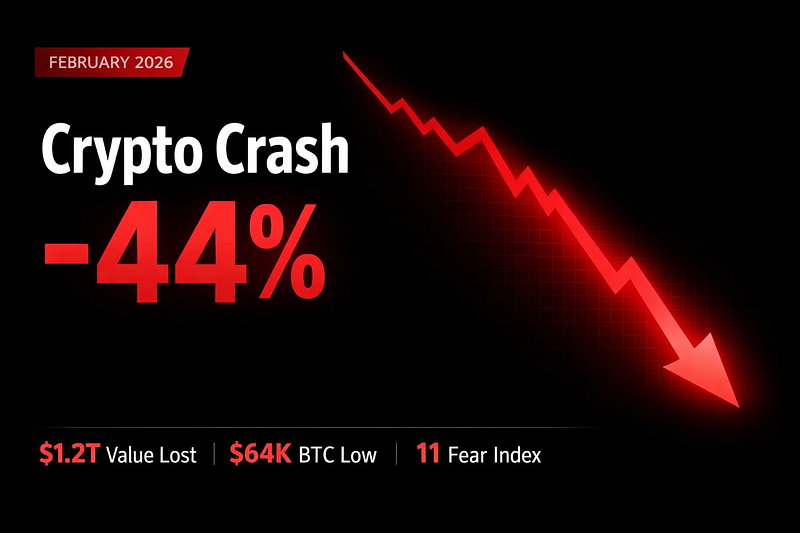
Bitcoin lost 44% from its October peak. The Fear & Greed Index hit 11. Here’s what the data tells us — and what separates survivors from…
Bitcoin lost 44% from its October peak. The Fear & Greed Index hit 11. Here’s what the data tells us — and what separates survivors from casualties.
The crypto market didn’t just dip this February. It broke.
Bitcoin fell from its all-time high of $126,000 in October 2025 to below $64,000 by February 5, 2026 — a 49% decline that wiped out more than $1.2 trillion in value. Ethereum dropped to $2,100. Solana broke below $100. The Crypto Fear & Greed Index plunged to 11, its lowest reading since November 2025.
And the worst part? This crash came at a time when crypto was supposed to be thriving.
Why This Crash Is Different
Previous crypto winters had clear triggers. Mt. Gox got hacked in 2014. ICOs imploded in 2018. FTX collapsed in 2022. Each crash had a villain.
This time, there’s no single culprit. Instead, it was a convergence of structural weaknesses:
Leverage was stacked too high. On February 5 alone, the market recorded $3.2 billion in realized losses — surpassing even the FTX collapse. Overleveraged positions cascaded into forced liquidations, which in turn triggered more selling.
Institutional money became a liability. Bitcoin ETFs, once celebrated as crypto’s bridge to Wall Street, turned into exit ramps. BlackRock’s ETF alone saw $373 million in outflows on a single day. When institutional money leaves, it doesn’t trickle — it floods.
The “digital gold” narrative collapsed. While Bitcoin dropped 26% year-to-date in 2026, gold surged 11% in the same period. Gold hit nearly $5,595 per ounce. Investors chose the real haven over the digital one.
Macro liquidity turned hostile. The Federal Reserve didn’t raise rates, but it didn’t need to. Trade-war threats with South Korea, geopolitical tensions over Greenland and Venezuela, and AI-related stock volatility created a risk-off environment that crypto couldn’t escape.
The Exchange Problem Nobody’s Talking About
Here’s what most analysis misses: during the crash, several exchanges experienced withdrawal freezes, degraded performance, and system outages at the exact moment traders needed to exit positions.
This is the dirty secret of crypto crashes — the infrastructure often fails when you need it most.
Not every exchange handled it the same way. Some smaller platforms actually performed better during peak stress because their systems weren’t overwhelmed by the sheer volume of panic selling. The key differentiator wasn’t size — it was architecture. Exchanges built for high-frequency derivatives trading with millisecond-level matching engines held up. Those running on duct tape and marketing budgets did not.
If you’re evaluating where to trade during volatile markets, look for: proof of reserves (verifiable on-chain), insurance funds (not just promises), millisecond execution speeds, and transparent fee structures that don’t spike during volatility.
One platform that’s gained traction among derivatives traders during this period is Bitunix — a Singapore-based exchange that maintained full withdrawal access and system uptime throughout the crash. They’re currently running a signup promotion with code BITUNIXBONUS that gives new users up to 7,700 USDT in bonuses and instant VIP 2 status for 30 days. For traders looking to position for the recovery with lower fees (77.7% discount), it’s worth considering: Sign up here.
What Happens Next?
Crypto winters typically last about 13 months, according to Bitwise CIO Matt Hougan. The current one arguably started in January 2025, meaning we could be approaching the end — or the middle.
Stifel’s Barry Bannister has projected Bitcoin could bottom around $38,000 — a 70% decline from its peak. That’s within historical norms for crypto bear markets. In 2018, Bitcoin fell 74%. In 2022, it fell 77%. Each time, it recovered to new highs within 18 months.
The question isn’t whether crypto will recover. It always has. The question is whether you’ll be positioned correctly when it does.
Three things smart traders are doing right now:
- Reducing leverage to near-zero. This is not the market for 50x positions. The survivors of every crypto winter are the ones who stayed solvent.
- Moving to exchanges with verifiable reserves. If your exchange can’t prove they hold your funds 1:1, you’re adding counterparty risk on top of market risk.
- Dollar-cost averaging on the way down. The worst time to buy, in hindsight, is always the best time to buy in foresight. But only with capital you can afford to lose.
The February 2026 crash will be studied for years to come. Not because of how much was lost, but because it revealed how deeply crypto has been absorbed into the traditional financial system it was designed to replace. For better or worse, Bitcoin now trades like a tech stock. And tech stocks crash.
The ones who survive this won’t be the loudest voices on Twitter. They’ll be the ones who managed risk, chose reliable infrastructure, and had the patience to wait for exhaustion to turn into opportunity.
Disclaimer: This article is for informational purposes only and does not constitute financial advice. Trading digital assets involves significant risk. Always do your own research.