Fidelity Launched a Stablecoin.
@MarioNawfal covered X Money’s beta launch. @intocryptoverse says capital flows toward durability. The $316 billion stablecoin market is…
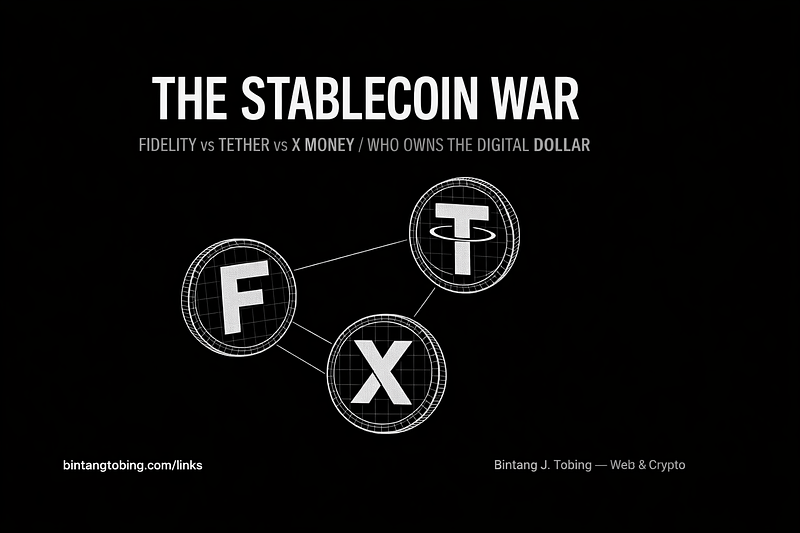
Fidelity Launched a Stablecoin. Tether Went U.S.-Compliant. Elon’s Building X Money. Here’s Why You Should Care More About This Than Bitcoin’s Price.
@MarioNawfal covered X Money’s beta launch. @intocryptoverse says capital flows toward durability. The $316 billion stablecoin market is where the real war is happening — and the GENIUS Act just armed every major player.
While everyone was watching Bitcoin bleed from $126K to $67K, three of the most consequential moves in crypto history occurred in 10 days. And almost nobody in retail is paying attention.
On January 27, Tether launched USAT — its first U.S.-compliant stablecoin. On January 28, Fidelity Investments announced FIDD — the Fidelity Digital Dollar — on the Ethereum network. On February 11, @elonmusk confirmed that X Money’s external beta launches in 1–2 months, with Visa as its payments partner and ~600 million monthly active users as the target market.
@MarioNawfal covered the X Money announcement on X, calling it a potential game changer. @intocryptoverse said “capital eventually flows toward durability.” And @Cointelegraph noted the Fear & Greed Index hit 5 — record low — the same week this infrastructure was being deployed.
Three different approaches to the same prize: America’s digital dollar. And the GENIUS Act just made the race legal, regulated, and institutional.
Let me break down who’s building what, why it matters, and what it means for you.
The GENIUS Act: Why Everything Changed
On July 18, 2025, President Trump signed the Guiding and Establishing National Innovation for U.S. Stablecoins Act into law. It passed the Senate 68–30 and the House 308–122 — the kind of bipartisan vote that almost never happens in crypto.
What GENIUS requires: every stablecoin issuer must maintain 1:1 reserves in U.S. dollars, short-term Treasuries, or equivalent low-risk assets. Monthly public disclosures, certified by the CEO and CFO. Independent accounting firm examination. No interest or yield payments to holders. Stablecoin issuers above $10 billion fall under federal supervision (OCC). Those below $10 billion can opt for state regulation.
Critically, compliant payment stablecoins are explicitly excluded from being classified as securities or commodities. No SEC. No CFTC. A clean regulatory lane for the first time in crypto’s history.
This single piece of legislation removed the ambiguity that kept Fidelity, JPMorgan, and every major bank on the sidelines. Within six months of signing, we got FIDD, USAT, JPMD deposit tokens, and U.S. Bancorp testing on Stellar.
The stablecoin market now exceeds $316 billion. Tether (USDT) holds roughly $187 billion. Circle (USDC) holds $73–76 billion. Everyone else is fighting for the remaining ~$56 billion — and growing fast.
Player 1: Fidelity Digital Dollar (FIDD)
FIDD went live on Ethereum on February 4, 2026, with an initial supply of $59 million. Here’s why this matters more than the number suggests.
Fidelity manages $6.8 trillion in discretionary assets and $17.5 trillion in assets under administration. This is not a crypto startup launching a token. This is the second-largest asset manager on Earth putting its brand on a blockchain-native product.
FIDD is issued by Fidelity Digital Assets, National Association, a federally chartered national trust bank that received OCC conditional approval in December 2025. Reserves are held at Bank of New York Mellon in cash, cash equivalents, and short-term U.S. Treasuries. Daily disclosure of circulating supply and reserve NAV on fidelity.com.
Mike O’Reilly, President of Fidelity Digital Assets, framed it explicitly: “Having a stablecoin within our ecosystem opens the door for other financial services to be built on-chain, by us and others. It becomes a building block for more efficient infrastructure.”
Translation: FIDD isn’t the product. FIDD is the foundation of Fidelity’s entire on-chain financial services strategy — custody, trading, settlement, and, eventually, tokenized assets.
Currently on Ethereum only, with plans to expand to L2s and other chains. Available through Fidelity Digital Assets, Fidelity Crypto, and Fidelity Crypto for Wealth Managers. Also listed on major exchanges.
Player 2: Tether USAT
One day before Fidelity’s announcement, Tether launched USAT — its first stablecoin designed specifically for U.S. regulatory compliance under the GENIUS Act.
This is significant because Tether has historically operated offshore. USDT is the dominant stablecoin globally ($187B market cap), but it’s never been a U.S.-regulated product. USAT changes that calculation.
The same week, Tether also released MiningOS — an open-source mining operating system. Combined with their 140 tons of gold reserves ($24B+) and dominant stablecoin position, Tether is building the most vertically integrated operation in crypto: stablecoin issuance, gold reserves, mining infrastructure, and U.S. compliance.
Tether generated $10.1 billion in profit in the first 9 months of 2025. Most of that comes from yield on reserves — cash and Treasuries backing USDT. At rates of 3.50–3.75%, stablecoin issuers are printing money regardless of crypto prices. USAT extends that model into the regulated U.S. market.
Player 3: X Money
@MarioNawfal’s coverage of the X Money announcement highlighted the scale: Elon Musk confirmed on February 11 that X Money had completed its internal closed beta and would launch an external beta in 1–2 months.
X has ~600 million monthly active users. 1 billion installed users. Visa is the payments partner, providing Visa Direct for instant transfers. X Money LLC holds money transmitter licenses in 41 U.S. states plus D.C.
X Money isn’t a stablecoin (yet). It’s a digital wallet and P2P payment system built into X. But the crypto implications are enormous. Musk’s history with digital payments (co-founding X.com, which became PayPal), his public support for Bitcoin and Dogecoin, and the platform’s existing crypto-adjacent user base all point toward eventual crypto integration.
Anthony Scaramucci said it directly: “He’s going to build a super app, and I think he’s going to be using crypto. Will it be his own coin? Will it be a stablecoin? It will be something.”
If X Money integrates stablecoin payments — whether USDT, USDC, FIDD, or a proprietary token — it would instantly become the largest stablecoin distribution channel in the world. 600 million users with integrated wallets, connected to Visa’s payment rails.
The Competitive Landscape
Here’s the current scoreboard:
Tether (USDT): $187B market cap. Global dominant. Now entering the U.S. via USAT. Revenue machine ($10.1B profit in 9 months 2025).
Circle (USDC): $73–76B market cap. U.S.-native. GENIUS Act compliant. Preparing for what could be a massive growth year.
Fidelity (FIDD): $59M initial supply. Backed by the $17.5 T AUA institution. Building block for on-chain financial services.
JPMorgan (JPMD): Deposit token. Already operational within JPM’s institutional network.
Ripple (RLUSD): $1.3B market cap. Integrated with the XRP ecosystem. ETF tailwind.
PayPal (PYUSD): Launched in 2023. Expanding to Solana. ~$500M market cap.
X Money: Not yet a stablecoin. But 600M MAU + Visa + Musk = the wild card.
The race isn’t just about market cap. It’s about distribution channels, regulatory compliance, and institutional trust. Fidelity has the institutional brand. Tether has a global network. X has the user base. Circle has the regulatory track record. JPMorgan has the banking relationships.
Why This Matters More Than Bitcoin’s Price
@intocryptoverse is right: capital flows toward durability. And stablecoins are the most durable revenue model in crypto.
When BTC crashes by 47%, stablecoin issuers continue to earn yield on their reserves. When rates stay at 3.50–3.75%, a $187 billion reserve generates billions in risk-free income. The GENIUS Act legitimized this model, and now every major financial institution wants in.
The stablecoin market grew 28% year over year, with transaction volumes surpassing those of Visa and Mastercard combined in 2024, according to the World Economic Forum. This is not speculative. This is infrastructure.
For retail traders: the exchange you use to access stablecoins matters. During the February 5 crash, $2.65B in liquidations, Fear & Greed at 5 — stablecoin liquidity and exchange uptime determined whether you could exit positions or got stuck watching 504 errors.
I trade derivatives on Bitunix through this volatility. They maintained full operations throughout February 5, including withdrawals, API, and sub-millisecond execution. Top 10 on CoinGlass for open interest, $5B+ daily volume, on-chain Proof of Reserves, and a 30M USDC Care Fund.
For stablecoin pairs trading — USDT perpetuals, cross-margin — exchange infrastructure isn’t a nice-to-have. It’s the difference between managing risk and being managed by it.
Code BITUNIXBONUS: 7,700 USDT bonus, 77.7% fee discount, instant VIP 2.
→ Register on Bitunix with BITUNIXBONUS
Already VIP on Binance/OKX/Bitget? Get VIP+1 on Bitunix
What to Watch
The CLARITY Act — the market structure companion to GENIUS — is in Senate markup. If it passes, it creates regulatory clarity for the entire digital asset ecosystem, not just stablecoins.
X Money’s external beta launch in 1–2 months. Whether it integrates crypto will be the biggest distribution story of 2026.
FIDD’s growth trajectory. At an initial supply of $59M, it’s tiny. But Fidelity’s distribution through their crypto platforms and wealth management channels could scale this rapidly.
Tether’s USAT traction in the U.S. market. If Tether can bridge its global dominance into U.S. compliance, the stablecoin war gets very interesting.
The crash will end. The stablecoin infrastructure being built right now will still be operational — and generating billions — when it does.
Disclaimer: This is not financial advice. Trading digital assets involves significant risk. Do your own research before making investment decisions.
Follow me: bintangtobing.com/links