Big Tech Is Spending $650 Billion on AI This Year. Here’s What That Actually Means.
There’s a number circulating on Wall Street right now that deserves more attention than it’s getting: $650 billion.
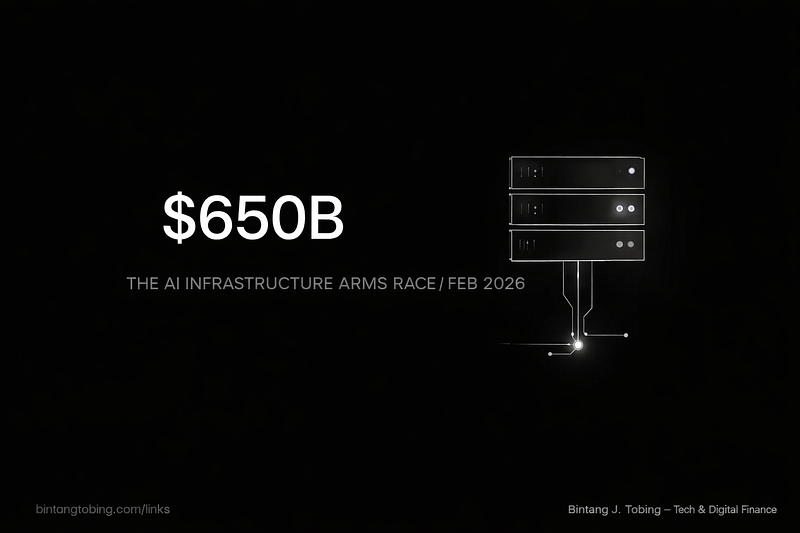
There’s a number circulating on Wall Street right now that deserves more attention than it’s getting: $650 billion.
That’s the combined capital expenditure that Amazon, Alphabet, Meta, and Microsoft have committed to spending in 2026 — almost entirely on AI infrastructure. Data centers. GPU clusters. Cooling systems. Fiber optic cables. The physical backbone of the AI economy.
To put that in context: $650 billion is more than Sweden’s entire GDP. It’s larger than the defense budgets of every NATO country except the United States. And it’s a 60% increase from last year’s already record-breaking $381 billion.
The individual numbers are staggering. Amazon is spending $200 billion — the company’s CEO, Andy Jassy, described AI demand as “just the beginning.” Alphabet is targeting $175 to $185 billion, doubling its previous year. Meta is projecting $115 to $135 billion, with its CFO, Susan Li, explicitly stating that AI investment is the company’s “highest order priority” above buybacks. Microsoft is pacing for $145 billion annually.
But here’s the part that should make everyone pay attention: the market isn’t celebrating.
When Spending Becomes a Risk
Amazon shares dropped nearly 6% after announcing its $200 billion plan. Microsoft is down 17% year-to-date. Morgan Stanley analysts project that Amazon’s free cash flow will turn negative — by $17 billion — in 2026. Meta’s free cash flow is expected to plummet by nearly 90%. Barclays analysts now model negative free cash flow for Meta in 2027 and 2028.
These aren’t companies in trouble. They’re enormously profitable businesses choosing to redirect virtually all of their cash into a bet on AI infrastructure. The question investors are asking is whether AI will generate returns fast enough to justify bleeding cash at this rate—or whether we’re witnessing the early stages of the most expensive bubble in corporate history.
The comparison to the late-1990s fiber-optic boom is whispered in analyst reports. Between 1998 and 2001, telecom companies spent hundreds of billions laying fiber across the world. Much of that infrastructure sat unused for a decade. The fiber eventually became essential — but many of the companies that built it went bankrupt before demand caught up.
The AI bulls argue this time is different. Cloud revenue is growing. Gemini Enterprise has sold 8 million seats. Microsoft’s AI-driven Office products are generating measurable enterprise adoption. The demand, they say, is already here.
The bears counter that the spending-to-revenue gap is widening, not narrowing. And the emergence of more efficient models — like the Chinese AI company DeepSeek, which demonstrated competitive performance at a fraction of the compute cost — raises uncomfortable questions about whether brute-force infrastructure spending is actually the path to AI dominance.
The SaaSpocalypse: AI Goes From Tool to Competitor
The tension between AI investment and AI disruption exploded into public consciousness on February 3, 2026.
That day, Anthropic — the AI company behind Claude — launched 11 plugins for its Claude Cowork platform. A legal plugin that automates contract review and NDA triage. A sales plugin that researches prospects and drafts personalized outreach. A finance plugin that builds financial models and tracks metrics.
Within 48 hours, $285 billion in market capitalization was wiped from global software, financial services, and asset management stocks. Goldman Sachs’ basket of U.S. software stocks recorded its steepest daily decline since April 2025. Jefferies’ equity trading desk coined a term: the SaaSpocalypse.
Thomson Reuters fell 16%. RELX dropped 13%. LegalZoom plunged 20%. The damage extended globally — Indian IT giants, including Infosys, TCS, HCLTech, and Wipro, all fell sharply.
The market’s logic was brutal in its simplicity: if an AI agent can log into enterprise tools and perform tasks autonomously, the value of the software interface collapses. Why pay per-seat licensing for 100 employees when 10 people plus AI agents can do the work? Anthropic’s head of enterprise product, Scott White, introduced the concept of “vibe working” — moving from clicking through software to simply describing outcomes to AI agents.
CNBC reporters demonstrated the implications in real-time: they built a functional Monday.com clone using Claude Code in under an hour. Cost: $5–15 in computing.
The $1.25 Trillion Merger: Infrastructure as Empire
The same week, Elon Musk completed the largest merger in history: SpaceX acquired xAI for $1.25 trillion.
The stated rationale was the use of orbital data centers. Musk argued that terrestrial power grids cannot sustain the energy demands of AI at scale, and that solar-powered data centers in space represent the only viable long-term solution. SpaceX filed with the FCC for authorization to launch AI satellites. The company had already been generating $8 billion in profit on $15–16 billion in revenue annually.
The practical reality is more nuanced. xAI was burning approximately $1 billion per month, lagging behind OpenAI and Google in model capabilities. The merger gives xAI access to SpaceX’s profitable operations and — crucially — positions both companies for a combined IPO that could reach $1.5 trillion.
But the strategic implication goes beyond finances. Musk now controls launch capacity (SpaceX), global internet connectivity (Starlink, with 9,000+ satellites and 9 million customers), AI models (xAI/Grok), and a social media distribution platform (X). That’s not a tech company — that’s a vertically integrated infrastructure empire.
The Invisible Crisis: AI Agent Security
While headlines focused on spending and mergers, a quieter but potentially more dangerous trend was accelerating.
A February 2026 survey of over 900 executives and technical practitioners found that 88% of organizations reported confirmed or suspected AI agent security incidents in the past year. In healthcare, that number reaches 92.7%.
The core problem is deceptively simple: organizations are deploying AI agents—software that can make decisions, access databases, and execute tasks autonomously—without treating them as independent entities that require their own security governance. Only 21.9% of teams treat AI agents as identity-bearing entities. The rest piggyback on human user credentials, creating a massive blind spot.
The scale is alarming. AI agents move 16 times as much data as human users. In one documented case, a single AI agent downloaded over 16 million files, while all other users and apps combined accounted for just one million. Only 14.4% of organizations report that all AI agents go live with full security and IT approval.
Gartner projects that by the end of 2026, 40% of enterprise applications will embed task-specific AI agents, up from less than 5% in early 2025. OWASP has released a dedicated AI Agent Security Top 10 for 2026. The U.S. government, through NIST, opened a formal request for information on AI agent security with comments due by March 9, 2026.
The Okta security team flagged what they call the “authorization gap”—scenarios in which an AI agent retrieves data with a privileged user’s permissions and then posts the results to spaces where recipients lack those permissions. Every step looks authorized from the agent’s perspective. But the net effect is data leakage without any traditional breach.
What Comes Next
Three forces are converging that will define the digital economy for the rest of 2026.
First, the infrastructure layer is consolidating. Only companies that can commit $100+ billion annually will control the AI compute layer. Everyone else becomes a tenant. This mirrors the cloud computing consolidation of the 2010s — but compressed and amplified.
Second, AI is shifting from augmentation to replacement. The SaaSpocalypse wasn’t an overreaction. It was a repricing of every business model that charges for human-facing interfaces. When agents can perform the work without opening the software, the software becomes overhead.
Third, security governance is becoming the critical bottleneck. The fastest-growing attack surface isn’t networks or endpoints — it’s AI agents with excessive permissions operating inside enterprise systems. Companies that solve this problem will build the next generation of security infrastructure.
For anyone paying attention, the question has shifted from “which AI company will win?” to “who controls the infrastructure that AI must flow through?” The answer points to cloud providers, identity platforms, and — increasingly — decentralized infrastructure alternatives that provide redundancy when four companies own most of the world’s compute.
Crypto exchanges and platforms at the intersection of technology and finance — such as Bitunix, which offers up to 200x leverage on BTC/USDT and ETH/USDT perpetual futures, with Proof of Reserves and Hacken-audited security — represent one piece of this alternative infrastructure layer. In a world where computational concentration creates systemic risk, financial infrastructure that operates independently matters.
The $650 billion has already been committed. The question now is who captures value — and who gets displaced.
Bintang J. Tobing is a technology writer covering the intersection of AI, infrastructure, and digital finance. Follow for weekly analysis on the forces reshaping the digital economy.